



Spotlights
Arborist, Tree Care Specialist, Tree Maintenance Technician, Tree Service Technician, Tree Pruning Technician, Tree Removal Specialist, Tree Health Technician, Urban Forestry Technician, Tree Climber, Tree Care Crew Member
There are three trillion trees growing around the planet and many of them live for hundreds of years. To stay healthy and trimmed, trees in public and residential areas require ongoing regular care and maintenance from skilled workers called Tree Technicians (aka arborists or tree trimmers).
They remove or treat diseased trees, apply pesticides and soil amendments, cut down branches and limbs that are close to houses and power lines, prune and trim for aesthetic purposes, and clear away trees that have fallen. To reach high parts of a tree they’re working on, they use climbing gear to carefully scale up, being very mindful of the sharp tools they take with them. Though the job is inherently risky, Tree Technicians are thoroughly trained to do the work safely!
- Working outdoors and staying physically active
- Helping trees stay healthy and pest-free
- Keeping community residents and properties safe from falling trees and limbs
- Improving property values
Working Schedule
Tree Technicians often work full-time but some positions may be part-time. Work schedules may vary by season. Frequent travel within a designated boundary (such as a city or county) is needed.
Typical Duties
- Review work schedules and prepare vehicles and equipment for transport to the worksite
- Review cost estimates and budgets with clients, when needed
- Assess worksites for potential hazards or risks to bystanders. Post warning signs around the perimeter
- Examine trees for signs of disease or pests
- Scale trees using climbing gear or use boom trucks to reach high tree limbs and branches
- Carefully hoist up tools to workers. Safely lower cut branches using ropes or pulleys
- Use hand or power saws to cut limbs and thick branches. Use pruning shears, loppers, and pole pruners for thinner branches
- Cut away branches or limbs that are close to power lines or houses or that might obstruct views along sidewalks or roads
- Trim trees to enhance their appearance and increase property values
- Remove or cut tree stumps
- Apply protective tar or other coatings to tree bases
- Feed tree waste into shredding and chipping machines
- Clear away tree debris from work sites and surrounding areas. Use rakes to clear smaller branches, twigs, leaves, etc. into piles, then shovel them up
- Load debris into trucks. Haul and properly dispose of debris
- Spray pesticides. Water, root-feed, and fertilize trees with soil amendments to keep them healthy
- Inject fertilizers into trees and perform soil root therapy to promote health
- Mix and apply pesticides and other chemicals
Additional Responsibilities
- Operate, maintain, load, and clean transportation vehicles and trailers
- As needed, operate boom trucks, loaders, stump chippers, tractors, skid steers, wood chippers, excavators, and hydraulic sprayers
- Regularly inspect, lubricate, and maintain tools and equipment. Perform basic repairs or sharpening, if trained
- Clear out decayed materials from tree cavities, and seal holes as needed
- Stabilize trees or limbs with braces, stakes, cables, or ties
- Carefully uproot and transplant trees and shrubs
- Train and mentor new workers and watch out for their safety as they learn the ropes
- Maintain constant vigilance of the work site to ensure no one is in the way of a potentially falling limb or tool
A Tree Technician spends much of their day working outdoors, helping maintain the health, safety, and appearance of trees in parks, residential neighborhoods, commercial properties, and public spaces. One morning, they might inspect trees for signs of disease, insect infestations, damaged branches, or structural problems. Later, they could prune branches, apply treatments, collect samples, or assist with planting and removing trees. They may also use specialized equipment such as chainsaws, climbing gear, wood chippers, and aerial lifts to perform maintenance work safely. Some Tree Technicians work alongside arborists, landscape professionals, and urban forestry teams to develop tree care plans and protect valuable trees. Their work helps keep trees healthy, prevent property damage, and maintain safe and attractive outdoor environments.
Soft Skills
- Detail-oriented
- Focus
- Goal-oriented
- Hand-eye coordination
- Initiative
- Methodical
- Observant
- Organized
- Patient
- Safety-focused
- Sound judgment and decision-making
- Strength and stamina
- Strong communication skills
- Time management
Technical Skills
- Ability to carry and load up to 70 lbs
- Ability to operate and maintain vehicles
- Ability to safely use hand and power saws, pruning shears, loppers, pole pruners, and other cutting tools
- First aid and CPR
- Familiarity with operating boom trucks, loaders, tractors, skid steers, wood chippers, excavators, and hydraulic sprayers
- Knowledge of soil and soil amendments
- Knowledge of tree/limb braces, stakes, cables, and ties
- Knowledge of tree pesticides, fertilizers, protective tars, and related chemicals
- Proper wear of personal protective equipment including helmets, gloves, and eye protection, as well as ropes, harnesses, lanyards,
- Strength and stamina
- Tree Care Technician: Performs routine tree maintenance, including pruning, watering, mulching, fertilizing, and monitoring tree health.
- Tree Climbing Technician: Uses ropes, harnesses, and climbing equipment to access tree canopies for pruning, inspections, and maintenance.
- Tree Health Technician: Examines trees for diseases, insect infestations, nutrient deficiencies, and environmental stress, and assists with appropriate treatments.
- Urban Forestry Technician: Helps manage and maintain trees in cities, parks, streets, and public spaces through inspections, planting, and maintenance programs.
- Tree Removal Technician: Assists with removing dead, diseased, hazardous, or unwanted trees using chainsaws, rigging systems, and other specialized equipment.
- Tree Planting Technician: Selects planting sites, prepares soil, plants young trees, and provides ongoing care to help them establish healthy root systems.
- Tree Inventory Technician: Surveys and records information about trees, including species, location, size, condition, and maintenance needs, often using GPS and mapping software.
- Plant Health Care Technician: Monitors trees and other plants for pests, diseases, and environmental problems and applies appropriate treatments to maintain their health.
- Federal, state, or local government agencies
- Landscaping and lawn care companies
- Botanical gardens
Tree Technician work requires constant exposure to outdoor elements, such as hot or cold weather, wind, rain, humidity, etc. There are many hazards that workers must guard against, including sharp tools, whirring chainsaw blades, heights, and exposure to noise, dust, chemicals, pests, and wildlife.
Per the Bureau of Labor Statistics, “Tree trimmers and pruners…have some of the highest rates of injuries and illnesses of all occupations.” Employers know the dangers of this profession and expect workers to comply with safety and emergency procedures and to wear appropriate personal protective gear. To the extent possible, Tree Technicians should plan out the work to be done ahead of time, and anticipate potential problems so they can avoid them.
Things don’t change too much in the tree care business, but a trend to note is the ongoing demand for more environmentally-friendly green practices. This can include the pesticides and fertilizers used on trees, as well as considerations about recycling tree debris. The industry is increasingly using drones in larger operations to gather visual data. There are even drones now equipped with saws for thinning forest trees!
Tree Technicians (aka climbers and groundsman arborists) are typically physically active people who don’t mind working outdoors with their hands. They’re comfortable with using hand tools and powered equipment and might have taken shop classes in high school. They may have grown up in rural areas, perhaps taking jobs helping out on farms. Strong verbal communication skills and teamwork are also essential, and these may have been developed from extracurricular activities like playing sports.
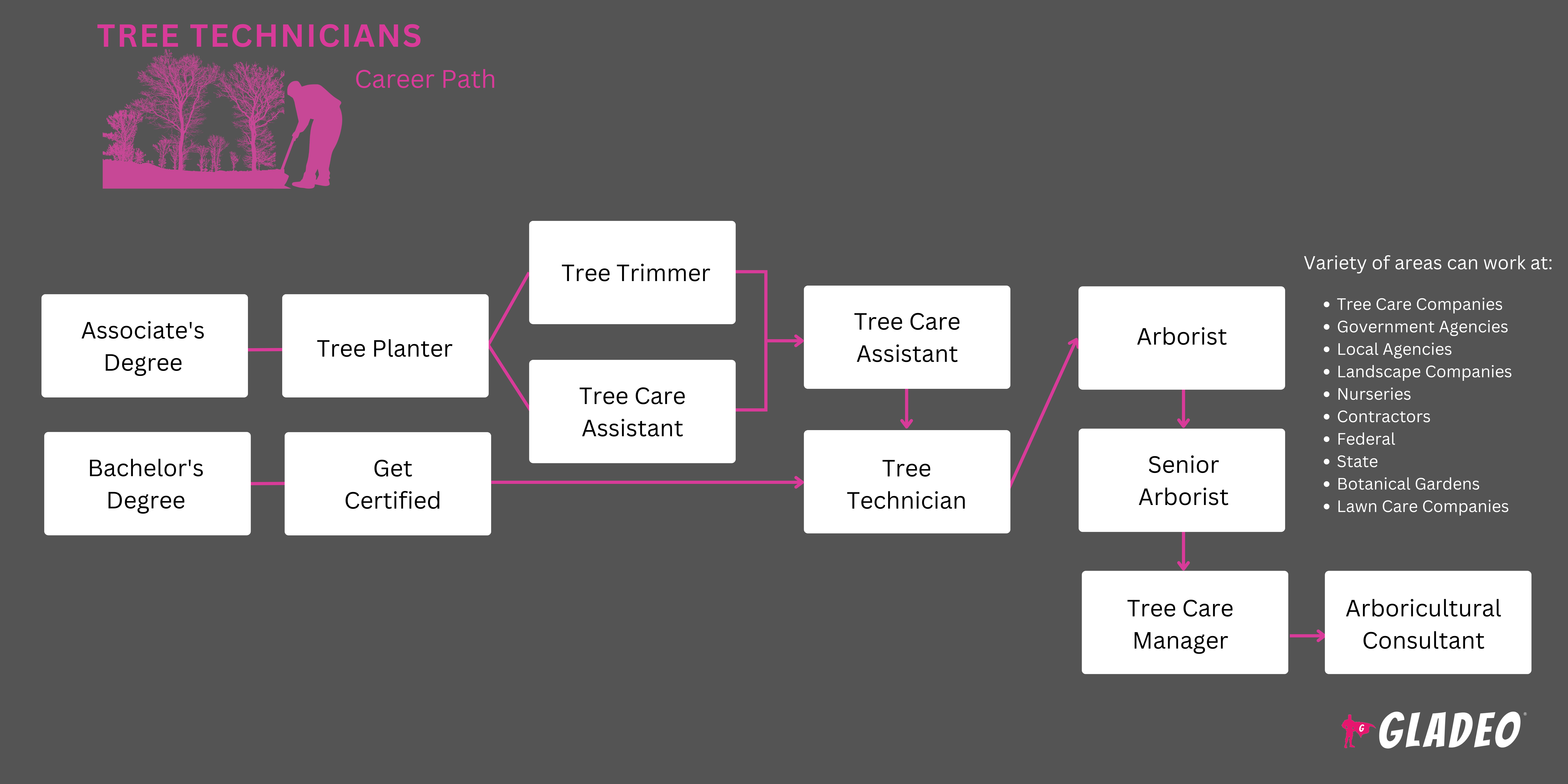
Becoming a Tree Technician typically requires a high school diploma or equivalent, along with practical training in arboriculture, horticulture, forestry, landscaping, or a related field. Some employers provide on-the-job training, while others prefer candidates with certificates, vocational training, or an associate degree in a relevant subject. These programs provide a foundation in tree biology, plant health, pruning techniques, pest management, and safe equipment operation.
Relevant coursework may include:
- Arboriculture: Studying the care, maintenance, cultivation, and management of individual trees, including proper pruning and tree health assessment.
- Tree Biology: Learning about tree anatomy, growth, root systems, photosynthesis, and how trees respond to environmental conditions.
- Horticulture: Studying plant cultivation, soil management, irrigation, fertilization, and landscape maintenance.
- Forestry: Learning about tree identification, forest management, conservation, and the sustainable use of tree resources.
- Plant Pathology: Understanding how fungi, bacteria, viruses, and other pathogens cause tree diseases and affect plant health.
- Entomology: Studying insects and other pests that damage trees, along with methods for identifying and managing infestations.
- Soil Science: Learning about soil composition, drainage, nutrients, and how soil conditions influence tree growth and development.
- Tree Pruning and Maintenance: Developing practical skills in removing dead or damaged branches, improving tree structure, and maintaining healthy growth.
- Pesticide and Plant Health Management: Learning how to identify pest problems and safely apply approved treatments when necessary.
- Workplace Safety and Equipment Operation: Learning to operate chainsaws, wood chippers, aerial lifts, climbing equipment, and other tools while following industry safety procedures.
Hands-on experience is especially important in this career. Students can gain experience through tree care companies, landscaping businesses, parks departments, botanical gardens, nurseries, and forestry organizations. Additional certifications may improve employment opportunities. In the United States, the International Society of Arboriculture (ISA) offers the Tree Climber Specialist and other professional credentials, although eligibility requirements vary. A bachelor's degree is generally not required for entry-level Tree Technician positions, but further education can help those interested in advancing into arborist, urban forestry, or tree management roles.
- Take biology, environmental science, agriculture, horticulture, and chemistry classes to develop a foundation in plant biology and tree health.
- Join gardening, agriculture, forestry, or environmental clubs to explore an interest in trees and plant conservation.
- Volunteer at botanical gardens, parks, tree nurseries, or community tree-planting programs to gain hands-on experience.
- Learn to identify common tree species in your community and study their characteristics, growing conditions, and maintenance needs.
- Start a small gardening or tree-growing project to observe how soil, sunlight, water, and nutrients affect plant growth.
- Participate in environmental conservation activities, such as tree planting, habitat restoration, and invasive species removal.
- Learn basic tool safety and develop physical fitness, balance, and coordination for outdoor work.
- Read about arboriculture, urban forestry, tree diseases, pest management, and proper pruning techniques.
- Pursue a certificate, vocational program, or degree in Arboriculture, Horticulture, Forestry, Landscape Management, or a related field.
- Apply for internships or entry-level positions with tree care companies, landscaping businesses, parks departments, or forestry organizations.
- Gain practical experience in pruning, planting, tree inspections, soil assessment, and identifying common tree diseases and pests.
- Learn to operate chainsaws, wood chippers, aerial lifts, and other tree care equipment under proper supervision.
- Practice using climbing ropes, harnesses, and personal protective equipment while following established safety procedures.
- Learn basic GPS and GIS tools for mapping tree locations and maintaining tree inventory records.
- Explore professional certifications offered by the International Society of Arboriculture (ISA) and other recognized organizations.
- Keep a record of your tree care projects, field experience, equipment training, and relevant certifications to use for college and job applications.
- Hands-on learning and internships with tree care companies, landscaping businesses, parks departments, botanical gardens, or forestry organizations.
- Courses in arboriculture, tree biology, horticulture, forestry, soil science, plant pathology, pest management, and tree maintenance.
- Opportunities to practice tree identification, pruning, planting, tree inspections, soil assessment, and pest and disease identification.
- Access to tree climbing facilities, training grounds, chainsaws, wood chippers, aerial lifts, and other professional tree care equipment.
- Strong emphasis on workplace safety, including chainsaw operation, climbing techniques, fall protection, rigging, and personal protective equipment.
- Opportunities to participate in urban forestry, tree planting, tree preservation, landscape maintenance, and environmental conservation projects.
- Exposure to modern tree care technologies, including GPS equipment, GIS mapping, tree inventory software, and diagnostic tools.
- Training in tree risk assessment, hazardous tree identification, proper pruning techniques, and plant health care.
- Access to instructors with professional experience in arboriculture, tree care, urban forestry, horticulture, or landscaping.
- Opportunities to prepare for professional certifications offered by the International Society of Arboriculture (ISA) and other recognized organizations.
- Career services that help students find internships, apprenticeships, entry-level tree care positions, and employment opportunities in arboriculture and urban forestry.
- Smaller local companies may list job openings on Craigslist, while larger companies might post on Indeed or Angi. State and federal employers also use USAJOBS
- Try doing a Google search for local tree service providers and check out their websites. Even if you don’t see a job vacancy, you could still reach out to them about upcoming opportunities. Some companies offer arborist trainee internships and seasonal work
- If you take college courses related to arboriculture, ask instructors or fellow students about openings they’re aware of or connections they have. Many jobs are found through networking!
- Ask working Tree Technicians to ask how they landed their jobs
- Be ready to pass a drug screening test, if needed
- Make a list of potential personal references. Ask for permission to share their contact info
- During interviews, demonstrate your knowledge of the industry and highlight your commitment to safety. Be familiar with arborist terminology and applicable OSHA regulations
- Review sample arborist interview questions to practice your responses
- Arborist work has some of the highest injury rates of all professions, due to risks of falling or slipping, cuts from sharp tools and chainsaws, dropping tree branches and limbs, and exposure to inclement weather, noise, pests, and chemicals. Practicing outstanding safety at all times is a great way to show your employer that you’re a responsible worker
- Tree Technicians may qualify for additional responsibilities (and pay raises) by getting to work on time, working well with others, and taking care of tools, equipment, and vehicles
- Always continue learning new things! Ask your employer which ISA certifications you should get that would benefit the company
- For example, if they need someone on the team who can perform certain tasks or operate particular equipment, let them know you’re willing to do the training
- Work effectively as part of a team that gets the job done right, follows safety protocols at all times, doesn’t cut corners, and avoids mishaps
- Participate in professional organizations and be an asset to your employer’s company
- Train new workers patiently and thoroughly. Set high standards so they will learn to do the job safely
- Stay up to date on trends and industry changes—including OSHA regulations—that can help improve performance and reduce worker mishaps
Websites
- International Society of Arboriculture
- National Association of Landscape Professionals
- Professional Grounds Management Society
- Society of Commercial Arboriculture
- Tree Care Industry Association
Books
- Arborists’ Certification Study Guide, by ISA
- Groundie, by Jeff Jepson
- The Fundamentals of General Tree Work: 25th Anniversary Edition, by G.F. Beranek
The work of a Tree Technician can be exhausting and dangerous. While many people love this line of work, it’s not for everyone! If you’re curious about related career fields, consider some of the options below:
- Agricultural Worker
- Farmworker/Laborer
- Forest and Conservation Workers
- Greenskeeper
- Groundskeeper
- Landscaper
- Logging Worker
- Nursery Technician
- Pesticide Handler
- Tree Faller
Click here to download the infographic
Newsfeed

Featured Jobs
Online Courses and Tools
Annual Salary Expectations
New workers start around $40K. Median pay is $49K per year. Highly experienced workers can earn around $60K.