




Spotlights
Conservation Scientists, Conservationist, Environmental Analyst, Environmental Quality Scientists, Erosion Control Specialists, Land Reclamation Specialists, Land Resource Specialists, Research Soil Scientists, Resource Conservation Specialist, Resource Conservationist, Soil Conservationists
The world has a lot of mouths to feed, with over 8 billion people plus so many animals it’s impossible to count them all. Combined, we’re putting a strain on one of the planet’s most valuable resources—soil!
71% of the Earth’s surface is water, leaving just 29% for land. Of that land, only ~10-11% is arable soil that’s suitable for growing crops. Meanwhile, other types of soil play vital roles in maintaining natural ecosystems, or in supporting urban structures.
Soil is fundamental to the continued existence of life as we know it. It’s so important, we now rely on dedicated Soil Conservationists to safeguard this precious resource. They assess the health and quality of soils, design measures to prevent erosion, and promote practices that enhance soil vitality.
Their work helps ensure the fertility of the ground for agricultural productivity. It also preserves the natural balance of ecosystems, prevents water pollution, and supports biodiversity!
- Getting to spend time peacefully working outdoors
- Supporting an invaluable resource needed to feed the population
- Helping the environment and supporting wildlife habitats
Working Schedule
Soil Conservationists work full-time jobs. Travel for fieldwork and site visits to farms, forests, or other sites may be needed. There could be exposure to inclement weather or hazards such as pests or chemicals.
Typical Duties
- Examine sites to assess topographical properties, such as soil types and qualities
- Meet and work with farmers and landowners to draft conservation plans
- Collaborate with applicable local, state, and federal agencies
- Create suitable soil conservation practices for sites
- Practices may include contour plowing, strip cropping, covering crops, terracing, crop rotation, planting trees and shrubs, creating tree windbreaks, no-till farming, installing ponds and grass waterways, subsoiling, mulching, erosion control blankets, managed grazing, etc.
- Create a database of soil types, erosion data, and actions taken
- Suggest amendments to improve soil health
- Monitor the effectiveness of implemented practices; gauge the impacts on soil health
- Work with engineers and hydrologists to ensure that soil conservation efforts align with water conservation needs
- Monitor construction practices and offer guidance on erosion control
- Advise on water quality and conservation issues such as wetlands restoration
Additional Responsibilities
- Look for organizations to establish mutually-beneficial partnerships
- Write or assist with grant proposals to seek project funding
- Provide education and training to agencies and institutions, as needed
- Keep up to date on trends and best practices
- Participate in professional organization events, such as workshops and conferences
- Draft technical reports outlining findings and recommendations
- Train and mentor new conservationists
A Soil Conservationist spends much of their time helping farmers, ranchers, landowners, and communities protect the soil that supports their livelihoods. One day, they might visit a farm to check for soil erosion, examine drainage problems, or recommend ways to improve soil health. Another day, they could be mapping land, reviewing soil surveys, preparing conservation plans, or meeting with agricultural professionals to discuss sustainable farming practices. Some work takes place outdoors in fields, forests, and watersheds, while other tasks involve computers, research, and writing reports. Their ultimate goal is to help people use the land productively without damaging the natural resources future generations will depend on.
Soft Skills
- Accuracy
- Analytical
- Attention to detail
- Communication skills
- Continuous learning
- Customer service
- Detail-oriented
- Independent
- Initiative
- Methodical
- Monitoring
- Organized
- Patience
- Reliable
- Scheduling
- Sound judgment and decision-making
- Time management
Technical Skills
- Knowledge of soil science, including soil profiles and physics
- Basic chemistry and biology
- Hydrology, including water movement, water quality, and the ways to conserve and improve water resources
- Agronomy/crop science, including types of crops, growth cycles, and effects on soils
- Erosion control techniques, like terracing, strip cropping, contour plowing, cover crops, etc.
- Knowledge of agricultural equipment and machines
- Research and measurement-taking skills; basic land survey tools
- Databases and analytics programs for soil health information
- Land-use planning
- Geographic Information Systems (GIS)
- Remote sensing using satellite imagery or aerial photography
- Software for soil modeling and data analysis
- Conservation planning; wetlands preservation; environmental impact assessment methods
- Knowledge of governmental agencies, policies, and regulations
- Valid driver’s license (for some jobs)
- Agricultural Conservationist: Works with farmers to reduce soil erosion, improve soil health, manage water resources, and adopt sustainable farming practices.
- Erosion Control Specialist: Develops strategies to prevent soil from washing or blowing away, especially on farmland, construction sites, and hillsides.
- Soil Health Specialist: Helps landowners improve soil structure, fertility, organic matter, and biological activity through practices such as cover cropping and reduced tillage.
- Rangeland Conservationist: Works with ranchers and land managers to protect grazing lands, prevent overgrazing, and maintain healthy vegetation and soil.
- Watershed Conservationist: Focuses on protecting soil and water within watersheds by reducing runoff, sediment pollution, and land degradation.
- Urban Conservationist: Helps cities, developers, and property owners manage stormwater, prevent erosion, and protect soil during construction and landscaping projects.
- Private industries
- Conservation organizations
- Governmental agencies
- Colleges, universities, and other research facilities
Much rides on the important work of Soil Conservationists, who bear a lot of responsibility to ensure our valuable soil resources are protected and used efficiently!
They have to be able to conduct thorough soil surveys and studies, develop feasible conservation plans, reduce erosion, and help with proper water drainage and irrigation. Oversights and errors can lead to mistakes that cost farmers and businesses money and may be harmful to the environment and wildlife habitats.
Soil conservation is in the spotlight because of increasing awareness of the pivotal role soil plays in our climate, food security, and ecosystem health.
Regenerative agriculture is a trend that goes beyond sustainable farming by actively improving the health and vitality of soils. This includes practices like no-till or reduced tillage, which minimizes soil disturbance; cover cropping; and crop rotation and diversification. These techniques enhance soil health and boost its ability to capture carbon from the atmosphere.
Another trend is the nurturing of soil microbiomes, in which microorganisms promote soil health and plant growth, reducing the need for chemical fertilizers and pesticides. In addition, digital agriculture technologies such as drones, sensors, and machine learning algorithms are being used to monitor soil health, predict erosion patterns, and optimize irrigation.
Soil Conservationists may have always loved to work outside in natural settings. They could have grown up in rural settings, such as around farms, fields, or forests. They care about wildlife and the environment, and are patient and meticulous—traits that could have come from any number of childhood experiences!
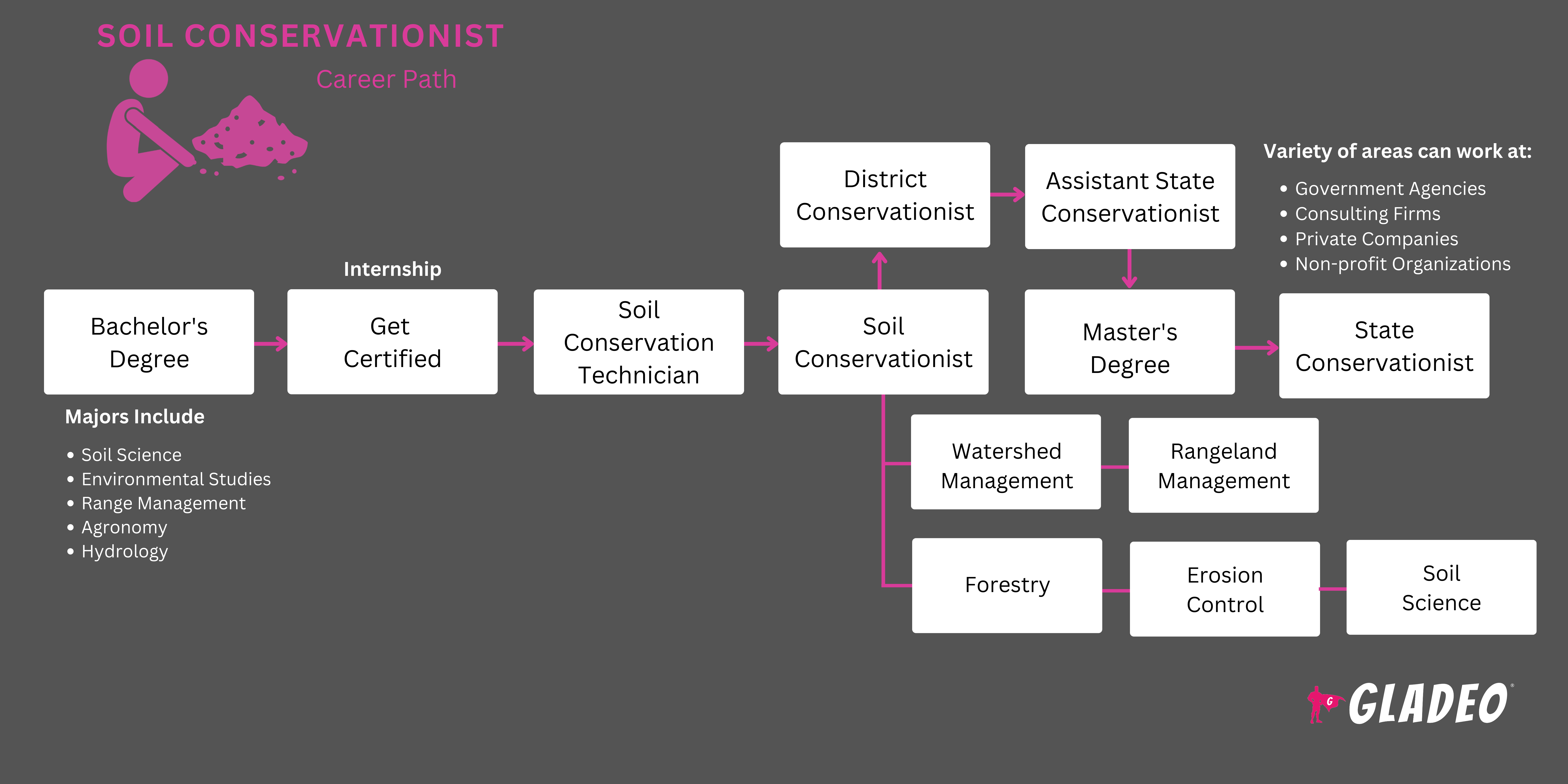
- Soil Conservationists usually have at least a bachelor’s degree. There is no single required major. Some major in plant/crop or soil science, others in horticulture, chemistry, or even biology
- Common classes may include:
- Agronomy and crop science
- Climatology and soil-climate interactions
- Conservation planning and management
- Ecology and environmental science
- Environmental law and policy
- Erosion and sediment control
- Geographic information systems and remote sensing
- Hydrology and watershed management
- Land reclamation and remediation
- Land use planning
- Soil chemistry
- Statistical methods
- Soil conservation workshop
- Learners who want to beef up their education in a specific area can consider ad hoc online courses from Udemy, HortCourses, Skillshare, and other sites
- Optional certifications such as Certified Professional Soil Scientist and Associate Professional Soil Scientist from the Soil Science Society of America can boost your credentials
- Take biology, chemistry, environmental science, geology, geography, and math classes to build a strong foundation in soil science and environmental studies.
- Join agriculture, gardening, science, or environmental clubs to develop an interest in soil health, farming, and natural resource conservation.
- Volunteer for tree-planting activities, community gardens, watershed cleanups, or local conservation projects to learn about protecting land and water resources.
- Visit farms, nature reserves, agricultural research centers, or soil conservation facilities to observe how soil is managed and protected.
- Start a small gardening or soil experiment project to compare soil types, drainage, nutrient levels, and plant growth under different conditions.
- Learn to identify different soil types and understand how soil texture, structure, and composition affect agricultural productivity.
- Participate in science fairs or research projects involving soil erosion, composting, water filtration, soil fertility, or sustainable agriculture.
- Read about soil conservation, erosion prevention, regenerative agriculture, and environmental sustainability.
- Pursue a degree in Soil Science, Agronomy, Environmental Science, Natural Resources Management, Agricultural Science, or a related field.
- Apply for internships with the USDA Natural Resources Conservation Service (NRCS), Soil and Water Conservation Districts, agricultural research centers, universities, or environmental organizations.
- Gain practical experience in soil sampling, soil testing, land assessment, erosion monitoring, and conservation planning.
- Learn to use Geographic Information Systems (GIS), GPS equipment, remote sensing technology, and data analysis software to evaluate land conditions.
- Participate in research projects involving soil health, watershed protection, sustainable farming, and land restoration.
- Develop communication and problem-solving skills by working with farmers, landowners, researchers, and conservation professionals.
- Keep a record of your fieldwork, research projects, internships, soil assessments, and conservation activities to use for college and job applications.
- Accreditation: Choose an accredited college or university offering recognized programs in soil science, agronomy, agriculture, environmental science, or natural resources.
- Relevant Coursework: Look for classes covering soil science, soil chemistry, soil fertility, hydrology, geology, erosion control, and sustainable land management.
- Hands-On Learning: Choose programs that provide access to agricultural laboratories, research farms, field stations, and opportunities to conduct soil testing and land assessments.
- GIS and Mapping Training: Look for opportunities to learn Geographic Information Systems (GIS), GPS technology, remote sensing, and digital mapping tools used in conservation planning.
- Internship Opportunities: Consider schools with connections to the USDA Natural Resources Conservation Service (NRCS), Soil and Water Conservation Districts, agricultural agencies, and environmental organizations.
- Research Opportunities: Look for programs that allow students to participate in research involving soil health, erosion prevention, water conservation, climate resilience, and sustainable agriculture.
- Career Preparation: Choose a program that provides field experience, professional networking, and guidance on meeting the education and qualification requirements for conservation careers.
- Check out job portals like Indeed.com, LinkedIn, Glassdoor, Monster, CareerBuilder, SimplyHired, ZipRecruiter, USAJOBS, AgCareers.com
- Note, the Inflation Reduction Act helped create more conservation job opportunities so keep an eye on the Natural Resources Conservation Service’s career page
- Take note of important keywords in job postings. Work them into your resume and cover letters
- Apply for soil conservation technician jobs where you can get experience helping conservationists with data collection, surveying and design activities, staking, field investigations, inspections, public outreach, and other tasks
- Check out Soil Conservationist resume examples and search online for sample interview questions
- Tell everyone in your professional network that you’re looking for work
- Consider relocating to where there are more job openings
- The states with the highest employment numbers for Conservation Scientists are Texas, California, Colorado, Mississippi, and Pennsylvania
- The states with the highest concentration of jobs are Montana, Alaska, South Dakota, Mississippi, and North Dakota
- The states that pay the most for these jobs are Washington D.C., Hawaii, Maryland, Minnesota, and Nevada
- Ask your college professors, former supervisors, and/or coworkers if they’re willing to serve as personal references. Don’t give out their personal contact information without prior permission
- Do mock interviews with your school’s career center or with your friends, so you’ll feel prepared and more relaxed during real interviews
- Dress appropriately for interviews and show your enthusiasm for and knowledge of the field
- Let your supervisor know you want to take on additional responsibilities and are willing to undergo additional training, as needed. Be sure you understand the promotion criteria
- Document your successes and contributions!
- Be proactive. Volunteer for challenging projects or tasks that might be outside your regular duties. Identify areas where improvements can be made in current conservation practices and suggest solutions
- Knock out a specialty certification such as Certified Professional Soil Scientist or Associate Professional Soil Scientist from the Soil Science Society of America
- Consider completing a master’s or PhD, if warranted
- Develop and refine your technical skills related to soil analysis, erosion control, conservation planning, etc.
- Keep up with environmental trends and challenges that impact soil. Learn about emerging technologies through continuing education courses, workshops, or conferences
- Stay very familiar with local, state, and federal regulations and policies regarding soil conservation
- Demonstrate independence, integrity, and leadership. Talk to colleagues to exchange information and tips. Teach and mentor others
- Collaborate effectively with team members and develop strong relationships with local environmental agencies
- Publish papers in high-impact journals like the Journal of Soil and Water Conservation to demonstrate your research skills and to get your work seen by a wider audience
- Ask if there are particular specialized hydroponics skills or systems you could learn that could benefit the business. Let them know you are willing to do the training and ask if they can offer tuition assistance
- Always practice good safety procedures and wear gloves or eye protection, as needed
- Engage with professional hydroponics organizations like the Soil Science Society of America. Attend meetings and events to learn and make connections
- When the time is right, consider applying to larger employers that may offer higher salaries or better promotion opportunities
Websites
- AgCareers.com
- American Farm Bureau Federation
- American Society for Horticultural Science
- American Society for Microbiology
- American Society of Agronomy
- Botanical Society of America
- Center for Disease Control
- Crop Science Society of America
- Department of Agriculture
- Dow AgroScience
- Ecological Society of America
- Entomological Society of America
- Environmental Protection Agency
- Farm Production and Conservation Business Center
- Forestry Service
- International Erosion Control Association
- Journal of Soil and Water Conservation
- Mycological Society of America
- National Alliance of Independent Crop Consultants
- National Environmental Health Association
- National Farmers Organization
- National Institute of Food and Agriculture
- National Institutes of Health
- National Park Service
- Natural Resources Conservation Service
- National Sustainable Agriculture Coalition
- Nature Conservancy
- Plant Based Foods Association
- Society of Nematologists
- Soil and Water Conservation Society
- Soil Science Society of America
- Syngenta
- The National Academy of Science
- U.S. Food and Drug Administration
- USDA Animal and Plant Health Inspection Service
- Weed Science Society of America
Books
- Below the Surface: Dive Deep into Soil Science and Discover the Foundations of Regenerative Agriculture, by James Mckenzie
- Dirt to Soil: One Family’s Journey into Regenerative Agriculture, by Gabe Brown
- Sustainable Agriculture and Soil Conservation Hardcover, by Mirko Castellini (Editor), et. al.
The Bureau of Labor Statistics projects a 4% rise in jobs for conservationists in general over the next decade. However, that figure may grow thanks to the Inflation Reduction Act which is helping to create more conservation programs—and thus more job opportunities, for Soil Conservationists and other fields.
If you want to explore a few related types of jobs, check out some of the below options:
- Agricultural and Food Science Technician
- Agronomist
- Ecologist
- Environmental Scientist
- Grounds Maintenance Worker
- Horticulturist
- Landscaper
- Naturalist
- Pesticide Handler
- Plant Biologist
- Vineyard Manager
Newsfeed

Featured Jobs
Online Courses and Tools
Annual Salary Expectations
New workers start around $52K. Median pay is $68K per year. Highly experienced workers can earn around $87K.