






Spotlights
E-commerce Manager, Online Sales Manager, Digital Merchandising Manager, Web Merchandising Specialist, E-commerce Buyer, Online Purchasing Manager, E-commerce Procurement Specialist, Digital Product Manager, Online Retail Manager, Internet Merchandiser, Online Category Manager, E-commerce Operations Manager
When you shop online, every product you see arranged neatly, every sale promoted just right, and every checkout process running smoothly is thanks to the expertise of an Online Merchant or Purchase Manager. These professionals shape your online shopping experience by making sure the right products are available and presented attractively on websites.
Online Merchants and Purchase Managers plan, buy, and manage the products sold through online stores. They analyze market trends to select products customers want, negotiate with suppliers to get the best prices, and coordinate with marketing and web teams to optimize product listings and promotions. Their goal is to ensure that online shoppers find appealing, well-priced items that encourage sales.
Using data analytics tools, inventory management software, and digital marketing platforms, these managers track sales patterns and customer behavior to forecast demand and adjust purchasing strategies. Their role is crucial in balancing supply and demand, maximizing profits, and creating a seamless shopping experience that keeps customers coming back.
- Playing a key role in shaping the online shopping experience that millions of people enjoy every day.
- Using data and creativity to select products and promotions that excite customers and boost sales.
- Collaborating with diverse teams, from suppliers to marketers, to bring products from concept to customer's cart.
- Seeing the direct impact of your decisions in sales growth and customer satisfaction.
Working Schedule
Online Merchants and Purchase Managers usually work full-time during regular business hours, but because online retail is always active, they may need to respond to urgent issues or market changes outside typical hours. They often work in office settings or remotely, and their schedules can include busy periods around holidays or major sales events.
Typical Duties
- Researching market trends and customer preferences to select products for the online store.
- Negotiating contracts and prices with suppliers and manufacturers.
- Monitoring inventory levels and coordinating restocking to avoid shortages or overstock.
- Collaborating with marketing teams to plan promotions and product launches.
- Analyzing sales data to forecast demand and adjust purchasing strategies.
- Managing product listings and descriptions to optimize online presentation.
- Coordinating with logistics and fulfillment teams to ensure timely delivery.
- Maintaining relationships with vendors and resolving supply issues.
- Tracking competitor pricing and market positioning.
- Reporting on sales performance and purchasing metrics.
- Ensuring compliance with company policies and industry regulations.
- Evaluating new product opportunities and supplier options.
Additional Responsibilities
- Developing budget plans for product purchasing and inventory management.
- Training and managing junior purchasing staff or assistants.
- Handling customer feedback related to product availability and quality.
- Implementing new e-commerce technologies or tools to improve purchasing efficiency.
- Participating in cross-functional meetings to align purchasing with business goals.
- Staying updated on industry innovations and best practices.
- Managing risk related to supply chain disruptions.
- Supporting sustainability initiatives through ethical sourcing.
In the morning, an Online Merchant/Purchase Manager reviews sales reports and inventory levels to identify any urgent restocking needs or slow-moving products. They also check emails and messages from suppliers and internal teams to prioritize their day's tasks.
Midday typically involves meetings with suppliers to negotiate prices or delivery terms, as well as strategy sessions with marketing and web teams to coordinate upcoming product promotions or new launches. Throughout the day, they analyze market data and customer feedback to refine purchasing decisions.
In the afternoon and evening, they focus on updating product listings on the website, troubleshooting any supply chain issues, and preparing reports on purchasing performance. During peak sales seasons, they may work later to ensure everything runs smoothly and sales targets are met.
Soft Skills
- Strong communication and negotiation skills
- Analytical thinking and problem solving
- Attention to detail and organization
- Ability to work collaboratively across departments
- Adaptability to fast-changing market conditions
- Time management and prioritization
- Customer-focused mindset
- Creativity in product selection and promotion
- Decision-making under pressure
- Leadership and team management
- Resilience and stress management
- Critical thinking and strategic planning
Technical Skills
- Proficiency with e-commerce platforms (e.g., Shopify, Magento)
- Data analysis and sales forecasting tools
- Inventory management software
- Microsoft Excel and Google Sheets
- Customer relationship management (CRM) software
- Digital marketing basics and SEO understanding
- Supplier management systems
- Basic financial and budgeting skills
- Product information management (PIM) software
- Familiarity with logistics and supply chain software
- Online Retail Manager: Oversees the entire online retail operation including merchandising, sales, and customer service.
- E-commerce Buyer: Focuses primarily on selecting and purchasing products for online stores.
- Category Manager: Specializes in managing specific product categories to maximize sales and profitability.
- Digital Merchandising Manager: Concentrates on the presentation and promotion of products online.
- Procurement Specialist: Handles sourcing and purchasing with an emphasis on supplier relationships and contracts.
- Inventory Manager: Manages stock levels and replenishment to support e-commerce sales.
- Product Manager: Develops and manages product lines, often including online sales strategies.
- Supply Chain Coordinator: Ensures products move efficiently from suppliers to customers through the online channel.
- E-commerce retailers
- Online marketplaces
- Retail chains with online stores
- Wholesale distributors
- Manufacturers with direct-to-consumer sales
- Digital marketing agencies
- Supply chain and logistics companies
- Tech startups focused on online sales
- Consumer goods companies
- Fashion and apparel brands
- Electronics retailers
- Grocery delivery services
Online Merchants and Purchase Managers often face high-pressure situations, especially during major sales events or holiday seasons when product demand can spike unexpectedly. They must remain calm and decisive while managing multiple tasks and stakeholders.
Their work hours can extend beyond the typical 9-to-5, including evenings or weekends, to respond to urgent purchasing needs or market changes. Flexibility and availability can be crucial to keeping online stores stocked and competitive.
The role requires strong attention to detail and the ability to handle frequent changes in supplier availability, pricing fluctuations, and customer preferences, which can lead to stressful revision cycles and fast-paced decision-making.
- Increasing use of AI and machine learning for demand forecasting and personalized product recommendations.
- Growing importance of sustainability and ethical sourcing in purchasing decisions.
- Expansion of mobile commerce influencing product selection and presentation.
- Integration of augmented reality (AR) tools to enhance online shopping experiences.
- Adoption of omnichannel strategies blending online and offline retail.
- Rise of direct-to-consumer (DTC) brands changing supplier relationships.
- Greater reliance on real-time data analytics to optimize inventory and pricing.
- Automation of supply chain and procurement processes.
- Expansion of global sourcing with attention to supply chain risks.
- Use of social media analytics to influence product assortments.
Many Online Merchants and Purchase Managers were curious about how products are marketed and sold from a young age, enjoying activities like organizing collections, running small sales or lemonade stands, or exploring shopping websites.
They often showed early interest in technology and data, enjoying games or projects involving strategy, business simulations, or managing resources, which helped build skills useful in e-commerce.
Most Online Merchant and Purchase Manager roles require a bachelor's degree, often in business, marketing, supply chain management, or a related field. Some professionals gain experience through internships or entry-level positions in retail or e-commerce.
Students can take courses in relevant subjects such as:
- Business Management
- Marketing Principles
- Supply Chain Management
- E-commerce Fundamentals
- Data Analytics
- Consumer Behavior
- Negotiation and Sales
- Accounting and Finance
- Information Systems
- Digital Marketing
Hands-on experience through internships or part-time jobs in retail or online sales is highly valuable. Building a portfolio that demonstrates understanding of e-commerce platforms and purchasing strategies can help candidates stand out. Many employers also provide on-the-job training to develop specific tools and systems knowledge.
- Take classes in business, economics, and computer science to build a strong foundation.
- Participate in extracurricular activities like DECA or entrepreneurship clubs.
- Seek internships or part-time jobs in retail or with online businesses.
- Learn about digital marketing and data analysis through online courses or workshops.
- Develop skills in negotiation and communication.
- Practice organizing events or sales projects to build management skills.
- Use school resources to explore supply chain and purchasing concepts.
- Build familiarity with popular e-commerce platforms through tutorials.
- Read industry news to stay informed about online retail trends.
- Connect with professionals through networking events or mentorship programs.
- Choose programs with strong business and marketing curricula.
- Look for schools offering courses in supply chain management and e-commerce.
- Seek programs that provide hands-on experience with real-world projects or internships.
- Consider institutions with connections to local or national retail companies.
- Evaluate faculty expertise in digital commerce and procurement.
- Check for availability of workshops on negotiation and supplier management.
- Assess the quality of career services and job placement support.
- Look for programs that teach current e-commerce platforms and software.
- Prioritize schools with flexible learning options like online or hybrid classes.
- Ensure curriculum includes data analytics and consumer behavior.
- Find programs encouraging teamwork and cross-disciplinary projects.
- Research alumni success in e-commerce careers.
- Apply for internships or assistant roles with online retailers or purchasing departments.
- Build a basic portfolio showcasing any relevant projects or school work.
- Volunteer to help local businesses with their online sales or inventory management.
- Develop proficiency in popular e-commerce and inventory software through free online tutorials.
- Attend industry networking events and online forums to meet professionals.
- Create a LinkedIn profile highlighting your interests and skills in e-commerce.
- Practice interviewing by researching common questions for merchant or purchasing roles.
- Seek opportunities to assist with product listings or marketing campaigns at school or community organizations.
- Stay informed about current online retail trends and technologies.
- Ask for informational interviews with people working in online merchandising.
- Participate in competitions or challenges related to business or marketing.
- Prepare a resume that emphasizes organizational and analytical skills.
- Gain expertise in data analytics to improve purchasing decisions.
- Develop strong negotiation skills to secure better supplier deals.
- Build relationships across marketing, logistics, and finance teams.
- Take on larger product categories or lead purchasing for new markets.
- Earn certifications in supply chain or e-commerce management.
- Seek mentorship from experienced online merchants or managers.
- Stay current with emerging e-commerce technologies and trends.
- Demonstrate leadership by managing junior team members or projects.
Websites:
- National Retail Federation (NRF) - nrf.com
- E-commerce Times - ecommercebytes.com
- Shopify Blog - shopify.com/blog
- Internet Retailer - digitalcommerce360.com
- Supply Chain Management Review - scmr.com
- Retail Dive - retaildive.com
- Digital Commerce 360 - digitalcommerce360.com
- EcommerceBytes - ecommercebytes.com
- Modern Retail - modernretail.co
- LinkedIn Learning - linkedin.com/learning
- Coursera E-commerce Courses - coursera.org
- American Marketing Association - ama.org
- Procurement Leaders - procurementleaders.com
- EcommerceFuel - ecommercefuel.com
Books:
- E-Commerce 2023: Business, Technology, Society by Kenneth C. Laudon and Carol Guercio Traver
- Digital Marketing for Dummies by Ryan Deiss and Russ Henneberry
- The Everything Store: Jeff Bezos and the Age of Amazon by Brad Stone
- Supply Chain Management For Dummies by Daniel Stanton
- Negotiation Genius by Deepak Malhotra and Max Bazerman
If a career as an Online Merchant or Purchase Manager doesn’t work out or if you want alternatives, there are several related fields that use similar skills in business, marketing, and digital sales.
- Retail Store Manager
- Marketing Coordinator
- Supply Chain Analyst
- Product Marketing Specialist
- Digital Advertising Manager
- Inventory Control Specialist
- Customer Experience Manager
- Business Analyst
- Sales Representative
- E-commerce Content Manager
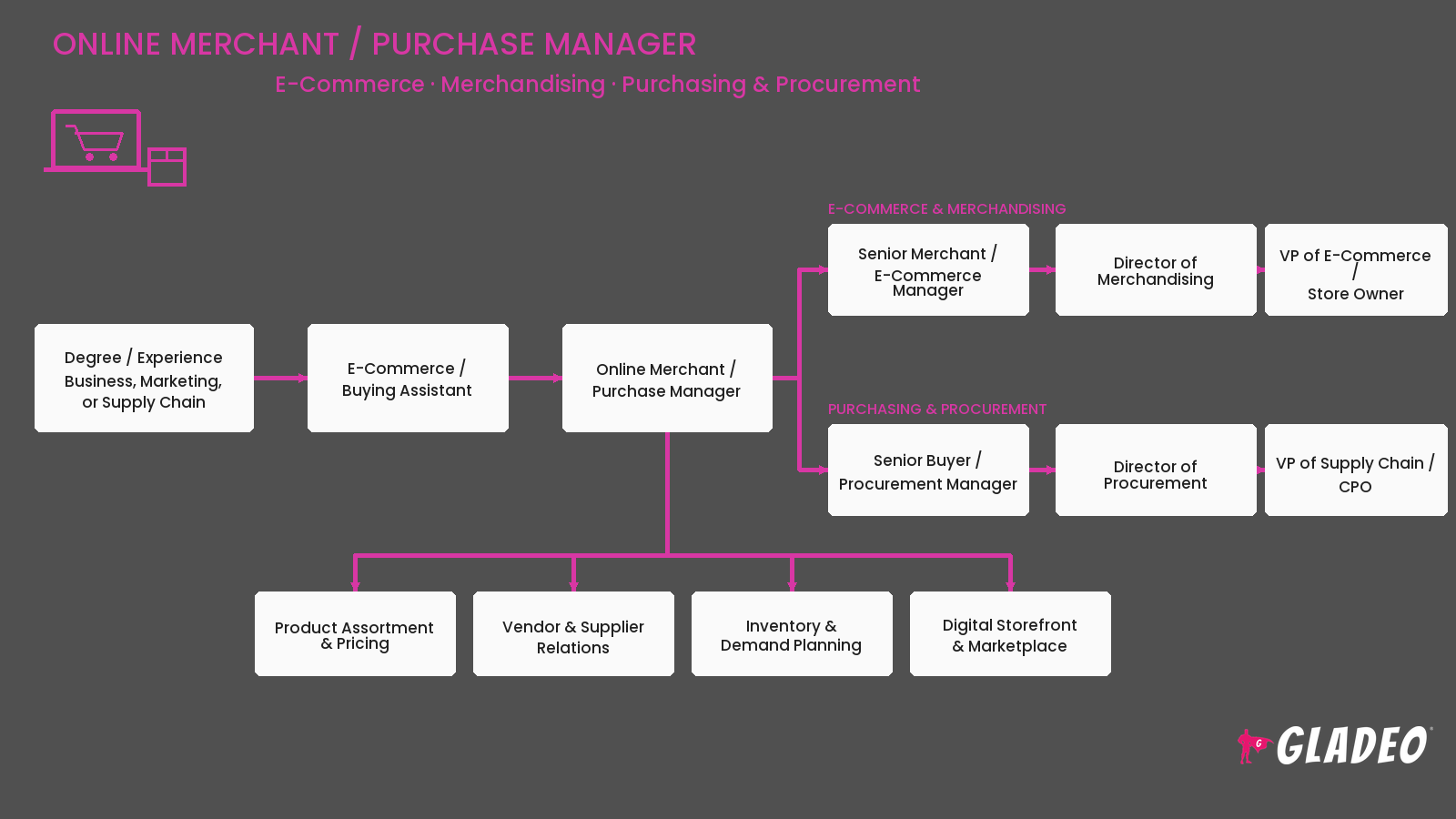
Click here to download the infographic
Newsfeed

Featured Jobs
Online Courses and Tools