





Spotlights
Store Manager, Sales Operations Manager, Retail Operations Manager, Sales Team Manager, Retail Supervisor, Sales and Merchandising Manager, Retail Store Director, District Sales Manager, Regional Sales Manager, Sales and Marketing Manager, Merchandising Manager, Sales Manager, Sales Representative, Department Manager
We’ve all been in stores and seen the displays of retail merchandise for sale. But rarely do we think about the “behind-the-scenes” of how all those products get there. That’s where Merchandise/Retail Sales Managers come in! They manage daily retail operations to ensure shoppers have access to an assortment of products—which the store hopes to sell so it can make a profit and continue its business.
A lot of work goes into selecting, ordering, receiving, pricing, and stocking merchandise on shelves and in displays. That’s why Merchandise/Retail Sales Managers don’t work alone; they usually lead a team that may include salespeople, stockers, cashiers, customer service clerks, and even security personnel. But at the end of the day, it’s up to the managers to make sure customers are getting the shopping experiences they want, so they’ll keep coming back!
- Learning how retail businesses operate
- Being part of a close-knit team that ensures customer satisfaction and helps boost company profits
- Good salary prospects with the potential for bonuses or commissions
- Receiving employee benefits, including store discounts
Working Schedule
Merchandise/Retail Sales Managers work full-time, sometimes at night or on weekends. Overtime may be necessary during busy seasons or events.
Typical Duties
- Review sales data to assess shopping trends and adjust inventory and sales plans accordingly
- Leverage technological tools to identify shopping habits
- Establish budgets and project estimated sales and profits
- Decide upon discount and promotional pricing for suitable merchandise or events
- Establish customer acquisition and retention strategies
- Determine the most effective marketing tactics
- Listen to and attempt to resolve sales- or service-related customer issues
- Manage or assign someone to manage inventory, including taking stock of items, receiving deliveries, reviewing invoices, and using inventory tracking software
- Work with sales team members and assign areas of responsibility
- Set reasonable sales quotas
- Organize training sessions and ensure training is documented and kept up-to-date
- Invest in team development so teams can become more effective and productive
- Provide timely feedback to employees about performance and inspire them to set and achieve goals
- Meet with marketing and advertising teams, warehouse managers, or research and design departments, as needed
- Interview and hire new workers
- Collaborate with dealers, distributors, and other external partners
Additional Responsibilities
- Understand and use point-of-sale and time-accounting programs, as needed
- Look for product cross-selling opportunities
- Review sales pitches, presentations, and other ideas to boost sales
- Review theft data and work with staff to mitigate losses
- Cooperate with law enforcement agencies, as applicable
- Review and update standard operating procedures
A Merchandise/Retail Sales Manager keeps a store running smoothly while making sure customers find the products they want and the business meets its sales goals. The day might start with checking sales reports, reviewing inventory, and meeting with staff to discuss promotions or daily targets. Throughout the day, they monitor how products are selling, adjust displays, coordinate restocking, and help resolve customer concerns. They may also review employee performance, prepare schedules, train new team members, and work with suppliers or buyers to make sure popular items stay available. Some days involve planning a seasonal promotion or analyzing why certain products are not selling. The job combines leadership, customer service, sales strategy, and business operations.
Soft Skills
- Analytical
- Attention to detail
- Communication skills
- Customer service
- Decisive
- Dependable
- Flexible
- Goal-oriented
- Independent
- Initiative
- Innovative
- Integrity
- Leadership
- Motivated
- Organized
- Patient
- Problem-solving
- Teamwork
Technical Skills
- Ability to train others
- Familiarity with products being sold
- General math skills
- Inventory management software
- Effective sales strategies and customer service
- Point of sale programs and equipment
- Retail sales environments and store operations
- Sales and marketing programs
- Transaction security software
- Understanding of organized retail theft
- Retail Store Manager: Oversees the daily operations of a retail store, including employees, customer service, inventory, and sales performance.
- Merchandise Manager: Plans which products a store should carry, monitors product performance, and helps determine pricing and inventory levels.
- Retail Sales Manager: Leads sales teams, sets sales targets, tracks results, and develops strategies to increase revenue.
- Department Manager: Manages a specific section of a store, such as clothing, electronics, home goods, or groceries.
- Visual Merchandising Manager: Oversees product displays, store layouts, and promotional arrangements to make merchandise appealing to shoppers.
- Multi-Store or District Manager: Supervises several retail locations, supports store managers, and makes sure each location meets company goals.
- E-Commerce Merchandising Manager: Manages how products are presented and promoted on online shopping platforms, including product listings, pricing, and digital sales campaigns.
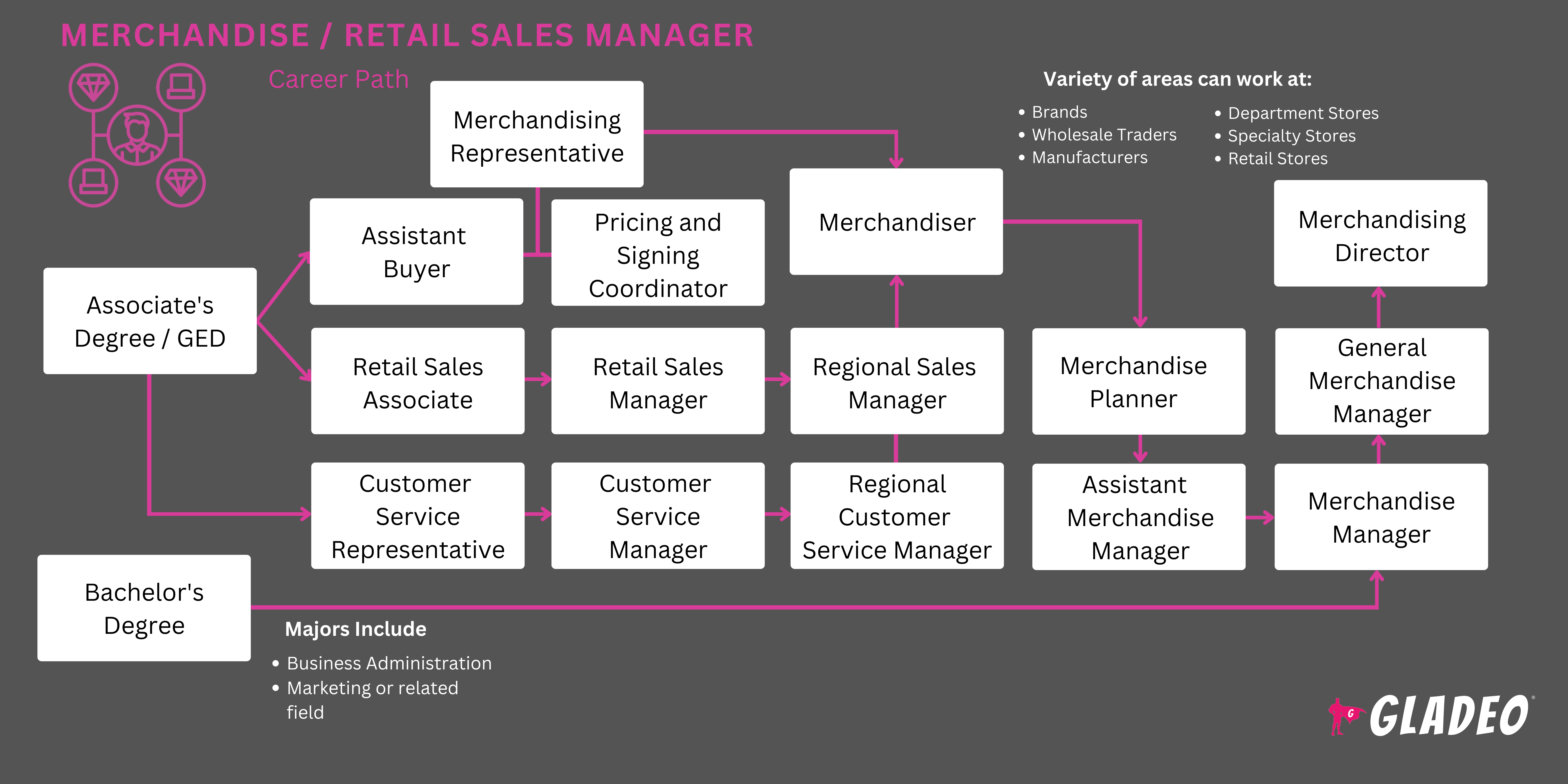
- Retail stores
- Wholesale traders
- Manufacturers
- Supermarkets & hypermarkets
- Specialty stores
- Discount stores & value retailers
- Big-box / warehouse clubs
- E-commerce & online retailers
- Franchise & chain stores
- Independent / local retailers
- Wholesale & B2B organizations
- Multinational / global retailers
Merchandise/Retail Sales Managers bear much of the responsibility for ensuring businesses are profitable. When a business fails to make money, it risks going out of business! Thus, in a sense, everyone’s job security depends, at least in part, on the performance of the sales manager.
Because of this, the position entails a fair amount of stress. It also involves working overtime during holidays and other major sales event days, like Black Friday, Cyber Monday, and Amazon Prime Day.
E-commerce makes up a significant portion of all retail sales these days. Online shopping is convenient, features wider product selections, and offers the potential for savings compared to buying the same item in-store. That’s why retailers continue to invest heavily in online stores and apps.
Meanwhile, customers have gotten used to more personalized experiences thanks to companies leveraging online data analytics to deliver customized campaigns, promotions, and product recommendations.
This has contributed to customers demanding even more, sparking competition between businesses that are fighting over the same target consumers. Thus, companies are turning to omnichannel retailing, integrating experiences between physical stores, websites, and mobile apps to offer more seamless and consistent shopping experiences.
Sales professionals are often outgoing and motivated to use their talents to earn more money. They tend to have a solid work ethic and may have started working at a young age. Many exhibit an entrepreneurial mindset early on, launching their own small business ventures. They feel confident and comfortable talking to others, a trait that could have come from participating in extracurricular activities in school or simply from being part of a big family.
Becoming a Merchandise or Retail Sales Manager typically requires a bachelor's degree in Business Administration, Retail Management, Marketing, Commerce, or a related field. These programs provide a strong foundation in business operations, customer service, sales strategies, inventory management, and the principles of running a successful retail business.
Relevant coursework may include:
- Retail Management: Learning store operations, merchandising planning, staff supervision, and daily business oversight.
- Marketing & Sales: Understanding how to promote products, set prices, analyze customer behavior, and meet sales targets.
- Inventory & Supply Chain Management: Studying how to order, track, store, and rotate merchandise while minimizing waste and shortages.
- Business Communication: Developing skills to interact clearly with customers, staff, suppliers, and head office teams.
- Financial Management: Learning how to read sales reports, manage budgets, control expenses, and calculate profit margins.
- Visual Merchandising: Understanding how to arrange displays, shelves, and products to attract customers and maximize sales.
- Customer Service & Relations: Studying how to resolve complaints, build loyalty, and create a positive shopping experience.
- Business Law & Ethics: Learning about consumer protection laws, employment regulations, contracts, and fair business practices.
- Human Resources Management: Understanding how to hire, train, schedule, motivate, and lead a retail team.
- Information Systems & Data Analysis: Learning to use point-of-sale systems, sales software, and reports to make informed business decisions.
Practical experience is especially valuable in this career. Students can gain experience through part-time retail jobs, internships at stores or shopping centers, on-the-job training programs, and seasonal sales roles. Many employers also value certifications in retail management, sales leadership, or customer service. An advanced degree such as a Master’s in Business Administration (MBA) may be required for senior management, district manager, or corporate leadership roles within large retail chains.
- High school students should take courses in business, finance, math, English, communications, information technology, statistics, psychology, and speech or debate
- Knowledge of a second language may be useful in many areas, so consider taking classes or doing self-study
- Participate in extracurricular activities where you can learn about teamwork, leadership, management, and project management
- Having sales experience is vital. Look for part-time jobs where you can rack up some sales or other retail experience
- A college degree isn’t always needed but will boost your credentials. A degree in business with a minor or concentration in retail management might provide the best educational foundation for some job openings, but others may want more of an accounting background
- Apply for relevant internships, through your school or on your own
- Read magazines and website articles related to retail and merchandising
- Consider doing ad hoc courses via Coursera or other sites to learn more about retail topics
- Request an informational interview with a retail manager at a local store. See if you can shadow one for a few hours
- Hands-on learning and internships at retail stores, shopping centers, wholesale companies, or brand marketing departments.
- Courses in retail management, sales strategies, merchandising, inventory control, marketing, and customer relations.
- Opportunities to plan product displays, analyze sales data, manage promotions, and handle real customer service situations.
- Access to modern retail technology, including point-of-sale systems, inventory software, sales analytics tools, and e-commerce platforms.
- Strong connections to retail chains, local businesses, shopping malls, industry associations, and wholesale distributors.
- Opportunities to participate in store operations, seasonal sales campaigns, visual merchandising projects, and inventory audits.
- Exposure to digital retail practices, online sales platforms, social media marketing, and omni-channel business strategies.
- Training in business communication, staff leadership, financial reporting, and problem-solving.
- Access to instructors with professional experience in retail operations, store management, sales, or merchandising.
- Check out job portals like Indeed.com, LinkedIn, Glassdoor, Monster, CareerBuilder, SimplyHired, or ZipRecruiter
- Don’t expect to start at a managerial level! Unless you already have years of relevant work experience, you’ll need to apply to entry-level positions first
- Many smaller jobs are advertised by local employers on Craigslist
- Review job postings closely and compare their required qualifications to your own background. Apply for the jobs you’re best qualified for, and continue to work on building up those qualifications!
- Stay in touch with your classmates and use your network to get job tips. Most jobs are still found through personal connections
- Ask your instructors or old bosses if they’re willing to serve as personal references
- Check out some Retail Sales Manager resume examples and sample interview questions
- Practice doing mock interviews and always dress appropriately for interviews!
- Consider relocating to an area with more job openings. States like California, Illinois, New York, Florida, and Massachusetts have the highest employment levels for sales managers in general, per the Bureau of Labor Statistics
- Keep track of what’s working in the retail industry, and use the knowledge to boost sales and avoid problems
- Become proficient in all software programs you need to know, whether it is for inventory or customer relationship management
- Train your team members well and develop strong, effective teams. Create a welcoming, motivational work environment
- Resolve customer issues quickly and try to ensure every customer feels satisfied and willing to continue doing business with your employer’s store. It’s much more cost-effective to keep an existing customer than to capture a new one
- “Increasing customer retention by 5% can increase profits from 25-95%,” notes Outbound Engine. “The success rate of selling to a customer you already have is 60-70%, while the success rate of selling to a new customer is 5-20%.”
- Communicate regularly with leadership, stakeholders, and third parties to ensure sales objectives and timeframes are clearly defined and attainable
- Tell your supervisor you’re interested in career progression and ask for their advice
- Earn a professional certification such as the National Association of Sales Professionals’ Certified Professional Sales Leader
- Consider earning a business or other related degree if you don’t have one (or a graduate degree, if you already have a bachelor’s)
- Keep active in professional organizations like the National Retail Federation, National Sales Network, or Professional Sales Association
- Continue to grow your network—and your reputation as a retail industry professional!
Websites
- American Association of Inside Sales Professionals
- Association for Talent Development
- Association of National Advertisers
- Association of Sales and Marketing Companies
- Franchise Direct
- Gift Sales Manager Association
- International Franchise Association
- International Mass Retail Association
- National Association of Sales Professionals
- National Association of Women Sales Professionals
- National Business Development Association
- National Retail Federation
- National Sales Network
- North American Association of Sales Engineers
- North American Retail Dealers Association
- Professional Sales Association
- Retail Industry Leaders Association
- Sales and Marketing Executives International
- Sales Management Association
- Strategic Account Management Association
Books
- How To Be A GREAT Salesperson...By Monday Morning!, by David R Cook
- Retail Gangster: The Insane, Real-Life Story of Crazy Eddie, by Gary Weiss
- The Retail Leader's Field Guide: How to Run a Kick-Ass Store Where Everyone Wants to Work, by Kit Campoy and Alicia Rust
The salary potential and job outlook for Merchandise/Retail Sales Managers both look pretty good. Still, this job isn't for everyone. The level of responsibility is high and the hours can get crazy during busy seasons. It also takes a few years of working in the industry to get qualified for a managerial position.
If you’re curious about some related career options, consider the below similar occupations!
- Advertising, Promotions, and Marketing Manager
- Insurance Sales Agent
- Market Research Analyst
- Public Relations and Fundraising Manager
- Purchasing Manager, Buyer, and Purchasing Agent
- Retail Sales Worker
- Sales Engineer
- Wholesale and Manufacturing Sales Representative
Newsfeed

Featured Jobs
Online Courses and Tools
Annual Salary Expectations
New workers start around $93K. Median pay is $135K per year. Highly experienced workers can earn around $196K.