




Spotlights
Fish Culture Technician, Fish Farm Technician, Aquaculture Technician. Fish Rearing Specialist, Hatchery Assistant, Aquatic Biologist Technician, Fishery Technician, Fish Health Technician
Fish hatcheries are facilities where fish eggs are hatched and raised under controlled, optimal environmental conditions where they can thrive. They are later transferred or released into other bodies of water. As U.S. Fish & Wildlife Service notes, hatcheries also “recover endangered or threatened species, “improve recreational fishing,” and “stock 98 million fish every year into rivers and lakes.”
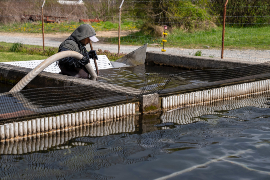
Fish Hatchery Technicians play an essential role in these operations. They do most of the manual tasks required to keep the hatcheries running smoothly. From taking care of the facilities and grounds to feeding the fish, keeping their water fresh and at an appropriate temperature, and even counting their eggs, Fish Hatchery Technicians are so important that some employers have them live on-site!
- Protecting fish and enabling conditions for them to propagate
- Helping to balance fragile ecosystems
- Ensuring sufficient fish populations for commercial use and fishing
Working Schedule
Fish Hatchery Technicians work full-time, with overtime possible during busy periods. They work outdoors in various weather conditions and perform a good amount of physical labor throughout the day.
Typical Duties
- Feed fish populations in controlled, specialized ponds, tanks, or other artificial channels (aka raceways)
- Ensure the water quality and temperature are suitable for the type of fish being taken care of, to closely emulate their natural habitats
- Some hatcheries receive freshwater or saltwater from natural sources; others use groundwater, municipal water, recirculated water in a closed-loop system, or even rainwater)
- Maintain equipment such as pumps, fish feeders, screens, filters, etc.
- Trap and sample fish from hatchery populations; monitor eggs as they hatch into the “fry” stage and grow into “fingerlings”
- Keep track of fish population numbers; maintain records of numbers and weights of fish released or sold
- Monitor for signs of microorganisms or disease
- Treat or segregate diseased fish quickly, and remove dead fish
- Harvest, count, and weigh eggs, as needed
- Transport fish and fish eggs; release mature fish into natural bodies of water to restock them. Distribute some fish to customers
- Perform general groundskeeping, including cutting grass and maintaining roads and trails
- Maintain facilities and vehicles; keep track of mileage driven; help order supplies and accept deliveries
Additional Responsibilities
- Limit or control access to certain off-limits facilities and production areas to reduce the risk of disease spread (note, some hatcheries are open to the public and even feature tours!)
- Respond to questions from visitors or the general public
- Create or follow emergency plans to address biosecurity incidents
- Keep up-to-date on employer policies and rules, as well as state and federal guidelines and regulations
- Assist with training new team members, volunteers, or community service workers
A Fish Hatchery Technician's day often begins with checking tanks, ponds, and other rearing facilities to make sure fish are healthy and their environment is suitable for growth. They may measure water temperature, oxygen levels, pH, and water quality, clean tanks, and inspect fish for signs of disease or stress. Some days involve feeding young fish, sorting them by size, or transferring them to larger tanks as they grow.
Much of the work revolves around helping fish reproduce and raising young fish until they are ready for release into natural waterways or transfer to commercial fish farms. Technicians may collect eggs, assist with spawning, monitor hatching, and care for newly hatched fish called fry. They also maintain pumps, filters, aeration systems, and other equipment that keep hatchery operations running smoothly. Whether working at a government fish hatchery, a commercial aquaculture facility, or a conservation center, Fish Hatchery Technicians play an important role in producing healthy fish for food production, recreational fishing, and the restoration of aquatic populations.
Soft Skills
- Accountability
- Detail-oriented
- Deductive reasoning
- Initiative
- Observant
- Organized
- Problem-solving
- Stamina
- Strong communication skills
- Time management
Technical Skills
- Basic computer skills
- Basic laboratory techniques
- Biology, wildlife, geography, and math
- Carry and load heavy objects
- Data entry, data collection, and recordkeeping
- Fish breeding (i.e., spawning, fertilization, egg collection, incubation, hatching)
- Fish health assessment, disease prevention, and treatment methods
- Hatchery policies, regulations, and laws
- Operate and maintain vehicles (i.e., small boats, ATVs, pickups, utility vehicles, snowmobiles, loaders, etc.)
- Operating/maintaining filtration systems and recirculation equipment, pumps, aerators, and feeding systems
- Small power tools (and firearms, for some jobs); calibration of specialized instruments
- Water quality management (i.e., temperature, pH, dissolved oxygen, and ammonia levels) and water dynamics (flows, flow patterns)
- Water safety, first aid, CPR
- Wear of personal protective equipment
- Freshwater Fish Hatchery Technician: Raises freshwater species such as trout, tilapia, catfish, and carp for food production, recreational fishing, or conservation programs.
- Marine Fish Hatchery Technician: Works with saltwater species, helping raise fish such as seabass, grouper, and snapper in controlled hatchery environments.
- Aquaculture Hatchery Technician: Supports commercial fish farming by breeding fish, caring for eggs and larvae, and producing healthy juvenile fish for aquaculture operations.
- Fish Breeding Technician: Assists with selecting broodstock, managing spawning activities, collecting eggs and sperm, and improving breeding success.
- Fish Larval Rearing Technician: Specializes in caring for newly hatched fish, monitoring their development, and providing appropriate food and water conditions during their early growth stages.
- Fish Conservation Hatchery Technician: Raises fish for stocking rivers, lakes, and other natural habitats to support threatened populations and restore aquatic ecosystems.
- Ornamental Fish Hatchery Technician: Breeds and raises aquarium fish for the pet trade, monitoring their health, reproduction, and development.
- Hatchery Water Quality Technician: Focuses on monitoring and maintaining water conditions, operating filtration systems, and ensuring that tanks and ponds provide suitable environments for fish.
- Commercial hatcheries
- Federal, state, or local government agencies
Per Cal Poly Humboldt, the following are potential employers for fisheries biology majors:
Federal agencies
- Army Corps of Engineers
- Bureau of Indian Affairs
- Bureau of Land Management
- Bureau of Reclamation
- Environmental Protection Agency
- Federal Power Administration
- Fish & Wildlife Services
- Forest Services
- Marine Advisory Extension Services
- National Marine Fisheries Services
- National Oceanic & Atmospheric Administration (NOAA)
- National Park Services
- Natural Resources Conservation Services
- Peace Corps
- Smithsonian Institute
- U.S. Customs Services
- U.S. Geological Survey
State & County agencies
- Fish & Game Departments
- Parks & Recreation Departments
- Public Aquariums
- Water Resource Control Boards
- Water Resource Departments
Private organizations
- Aquaculture & Mariculture Companies
- Aquarium & Pet Supply Companies
- Environmental Consultants
- Manufacturing Companies
Public utility companies
- Timber Product Companies
- Water Quality Monitoring Equipment
Fish Hatchery Technicians are responsible for monitoring fish and eggs, feeding fish, maintaining water quality in tanks and ponds, and cleaning equipment to ensure the fish and eggs under their care are healthy and able to thrive.
Fish Hatchery Technicians need to cultivate a good understanding of fish biology and behavior, so they can watch out for problems. They must follow strict protocols to prevent or control disease outbreaks that can endanger the hatchery’s entire fish population. Attention to detail, physical stamina, and the ability to work outdoors are all critical to do this job. Some technicians live at remote sites and may be required to carry a firearm.
In the field of fish hatcheries, there’s an increased focus on sustainable practices and conservation efforts. Many hatcheries are prioritizing the production of native and endangered fish species to restore and maintain natural ecosystems. This shift aligns with concerns about biodiversity loss and habitat degradation, driving hatcheries to play a more active role in preserving aquatic environments.
The integration of technology and data-driven approaches is another trend. Advanced monitoring systems, sensors, and automated feeding mechanisms are being adopted to optimize fish growth and health while allowing technicians to better track water quality parameters, feeding schedules, and fish behavior. Data analytics and modeling also help hatcheries adapt to changing environmental conditions and optimize resource allocation!
Fish Hatchery Technicians are typically physically active people who prefer working outdoors versus staying in an office all day. They may have always had a keen interest in fish, perhaps having aquariums—or just doing a lot of fishing in their younger days!
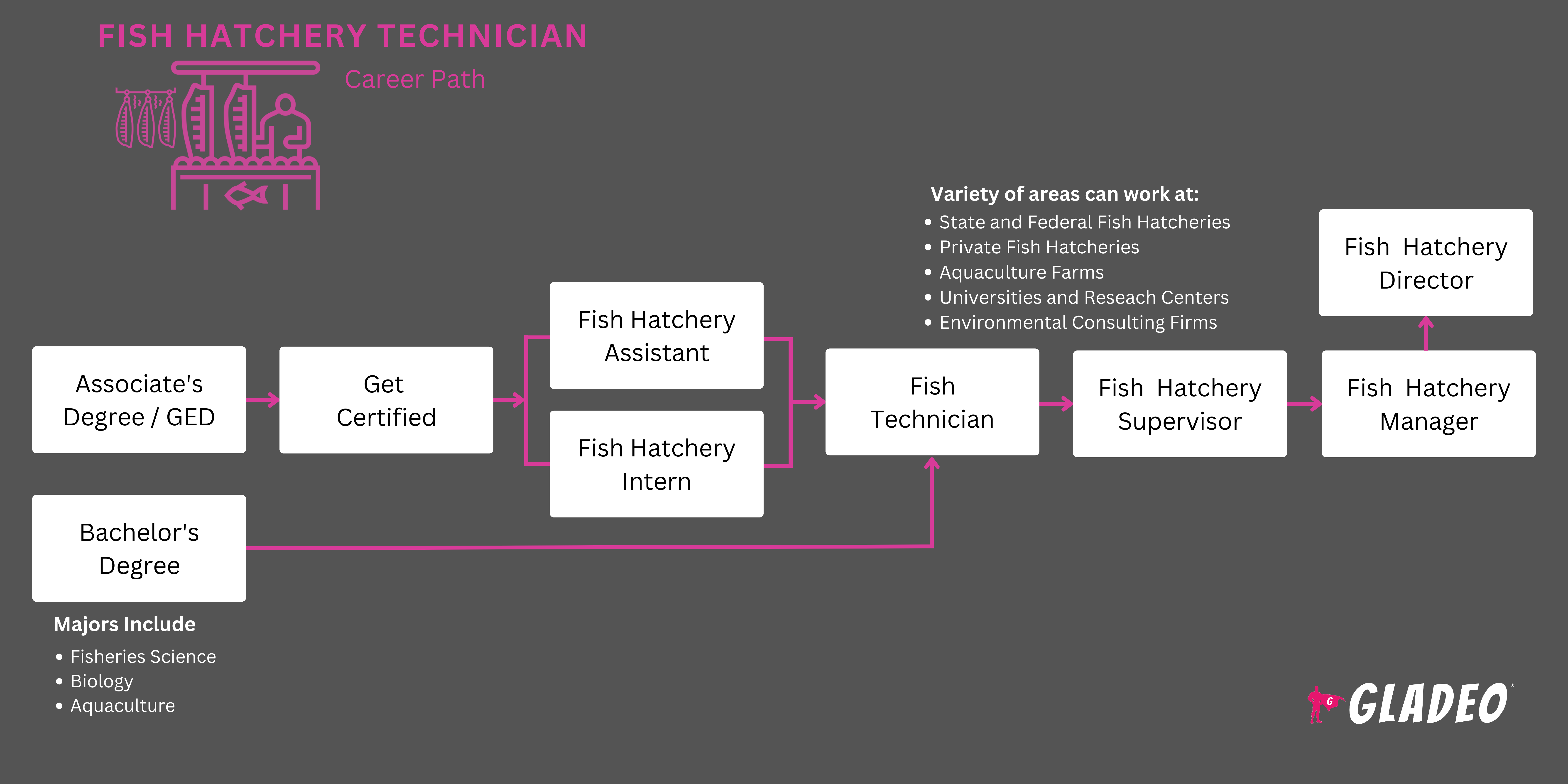
Fish Hatchery Technicians typically need a high school diploma or equivalent, although employers may prefer candidates with postsecondary education in Aquaculture, Fisheries Science, Fishery Technology, Marine Biology, or a related field. Technical schools, community colleges, and universities may offer programs that provide the scientific knowledge and practical skills needed to work in fish hatcheries.
Relevant coursework may include:
- Aquaculture: Learning how fish and other aquatic organisms are bred, raised, and managed in controlled environments.
- Fish Biology: Understanding fish anatomy, life cycles, reproduction, behavior, and environmental requirements.
- Water Quality Management: Learning how to measure and maintain temperature, dissolved oxygen, pH, salinity, and other water conditions.
- Fish Nutrition: Studying the nutritional requirements of different fish species and how to provide appropriate feed at various growth stages.
- Fish Health and Disease Management: Learning to identify common fish diseases, parasites, and signs of stress, as well as basic prevention and treatment practices.
- Hatchery Management: Studying spawning techniques, egg incubation, larval rearing, fish grading, and hatchery operations.
- Aquatic Ecology: Understanding aquatic ecosystems, water resources, and the environmental factors that affect fish populations.
- Aquaculture Equipment and Technology: Learning how to operate pumps, aerators, filtration systems, tanks, and water monitoring equipment.
Hands-on experience is especially important in this career. Students can gain practical skills through internships, laboratory work, and training at fish farms, government hatcheries, aquaculture facilities, and fisheries research centers. Depending on the employer and location, additional training in fish health, water quality testing, equipment maintenance, and aquatic animal handling may also be required.
- Take biology, chemistry, environmental science, and math classes to build a strong foundation in fish biology and aquatic systems.
- Join environmental, science, or agriculture clubs to gain experience with aquatic life and conservation activities.
- Volunteer at aquariums, fish farms, hatcheries, or environmental organizations to learn about fish care and aquatic habitats.
- Participate in science fairs or research projects involving water quality, fish health, aquatic ecosystems, or fish reproduction.
- Read about aquaculture, fisheries management, fish breeding, and sustainable seafood production.
- Pursue a degree or technical program in Aquaculture, Fisheries Science, Fishery Technology, or Marine Biology.
- Look for internships at commercial fish farms, government hatcheries, aquaculture research centers, or conservation facilities.
- Gain hands-on experience with fish feeding, egg incubation, water testing, fish handling, and tank maintenance.
- Learn to operate water quality testing equipment, filtration systems, aerators, and other hatchery tools.
- Keep a record of your projects, practical training, technical skills, and achievements to use for college and job applications.
- Hands-on learning and internships at fish hatcheries, aquaculture farms, or fisheries research facilities.
- Courses in aquaculture, fish biology, fish nutrition, water quality management, and hatchery operations.
- Opportunities to practice fish breeding, egg incubation, larval rearing, and fish health monitoring.
- Access to laboratories, fish tanks, ponds, and water testing equipment for practical training.
- Strong connections to commercial fish farms, government fisheries agencies, conservation organizations, and aquaculture businesses.
- Opportunities to participate in fish health research, breeding projects, and aquatic conservation activities.
- Exposure to modern hatchery technology, filtration systems, water monitoring equipment, and sustainable aquaculture practices.
- Access to instructors with experience in fisheries science, aquaculture production, or hatchery management.
- Training in fish handling, disease prevention, equipment maintenance, and workplace safety.
- Career services that help students find internships, hatchery positions, and employment opportunities in the aquaculture and fisheries industries.
- Check out job portals like Indeed.com, LinkedIn, Glassdoor, Monster, CareerBuilder, SimplyHired, ZipRecruiter, USAJOBS, etc.
- Take note of keywords in job postings. Tailor your resume to include them, while highlighting your relevant education and experience
- If you don’t have the necessary experience for certain jobs, don’t give up. Keep looking for entry-level or associated positions until you find one that you qualify for. If that doesn’t work, take a few classes to beef up your application
- Attend recruitment events. Many governmental agencies go to job fairs ready to hire. Come dressed nicely and prepared to ask questions and give mature responses
- If you take college courses, ask instructors or fellow students about openings they’re aware of or connections they have. Many jobs are found through networking!
- Ask working Fish Hatchery Technicians how they landed their jobs
- The U.S. Fish and Wildlife Service’s hatchery system features ~70 national hatcheries plus a handful of fish technology or health centers. Consider moving closer to one, if you want a job there. Otherwise, look for commercial hatchery locations!
- Make a list of potential personal references. Get permission to share their contact info ahead of time
- Brush up on hatchery practices and terminology. During interviews, demonstrate your knowledge of the fish hatchery business and highlight your commitment to safety—both for yourself and the fish!
- Review sample Fish Hatchery Technician resumes and interview questions
- Ask a friend (or your school’s career center) to help you run through some mock interviews
- Before going to an interview, make sure to study the employer’s website to learn more about their operation
- Take excellent care of the fish and eggs you are responsible for
- Ask questions and learn all you can about every aspect of the hatchery operation
- Let your supervisor know that you want to master your job and are interested in advancement opportunities when the time is right. Ask for their advice about what you should do to make yourself a stronger asset to the organization
- If a degree is required to advance, consider taking classes and see if the organization offers tuition assistance. Some employers might send you to classes if you ask
- Actively seek opportunities to gain leadership and managerial experience
- Practice outstanding safety at all times to show you’re a responsible worker!
- Maintain good physical fitness so you’ll have the stamina to do your duties
- Show up for work on time and take good care of tools, equipment, and vehicles
- Work effectively as part of a team and try to offer solutions to problems that come up
- Participate in professional organizations (see our list of Recommended Tools/Resources)
- Offer to give tours or teach workshops so you can get practice engaging with the public
- Learn about the sales and marketing side of the hatchery business
- Train new workers thoroughly. Set high standards so they will learn to do the job safely
- Stay up to date on trends and industry changes that improve performance and reduce health risks for fish and eggs
Promotions are typically based on a mix of your job performance, knowledge and skills, and alignment with the employer’s needs. By consistently excelling in your current role, displaying leadership qualities, and actively contributing to the hatchery’s success, you increase your chances of being considered for a promotion!
Websites
- AFS Fish Health Section
- American Association of Fish Veterinarians
- American Fisheries Society
- Aquaculture
- Aquatic Animal Drug Approval Partnership Program
- Bureau of Land Management
- Freshwater Fisheries Society of British Columbia
- Idaho AFS: History of Aquaculture in Idaho
- Journal of the World Aquaculture Society
- Long Live the Kings
- Maryland Shad Restoration
- National Aquaculture Association
- National Association of State Aquaculture Coordinators
- National Association of State Departments of Agriculture
- National Association of State Foresters
- National Park Service
- North American Journal of Aquaculture
- Northwest Indian Fisheries Commission
- Pacific Northwest Hatchery Reform Project
- The Return of American Shad to the Potomac River: 20 Years of Restoration
- The Wildlife Society
- U.S. Aquaculture Society
- U.S. Fish and Wildlife Service
- U.S. Forest Service
- USFWS Federal Hatchery Review
- Virginia American Shad Restoration
- World Aquaculture Society
Books
- Fish Hatchery Management, by American Fisheries Society
- Lessons in Leadership: Integrating Courage, Vision, and Innovation for the Future of Sustainable Fisheries, edited by William Taylor, Andrew Carlson, Abigail Bennett, and C. Paola Ferreri
- Methods for Fish Biology, edited by Stephen Midway, Caleb Hasler, and Prosanta Chakrabarty
- Trout and Salmon of the Genus Salmo, by Johannes Schöffmann
Fish Hatchery Technician work can, at times, be fun, exciting, dull, or dangerous. Every day comes with its own unique set of challenges. While many people love this line of work, it is not for everyone! If you’re curious about related career fields, consider some of the below options:
- Aquaculturist
- Aquatic Biologist
- Aquatic Ecologist
- Aquatic Pathologist
- Biological Technician
- Fish & Game Warden
- Fish & Wildlife Assistant
- Fish Behaviorist
- Fish Culturist
- Fisheries Biologist
- Fisheries Conservationist
- Fishery Scientist
- Fish Hatchery Manager
- Fish Health Inspector
- Habitat Restoration Specialist
- Marine Biologist
- Research Biologist
- Reservoir Manager
Newsfeed

Featured Jobs
Online Courses and Tools